
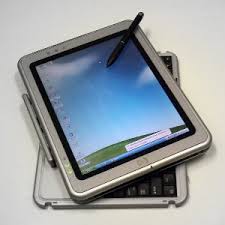
A physician friend asked me the other day, "Why do you use a tablet PC? What do you find so appealing about them?" This is a loaded question. After all, why would anyone spend extra cash to purchase a tablet PC if you can get a much less expensive laptop that has virtually the same (or better) capabilities?
Let me try to answer this with a few bullet points:
- I've been a pen-based computer user since the late 90's when the Apple Newton was around. Keep that in perspective as you read these next points.
- I love to "ink" or write on the screen and draw figures and diagrams when I'm taking notes. I use different color pens and I can easily circle things and draw arrows to indicate relationships and to mock up flow diagrams. You can't do that on a laptop.
- When in the hospital/clinic/office setting, the tablet interface is much more personable and less intrusive. I can comfortably hold the tablet in my hand/arm and I can look at the person in the face. People who use a keyboard are often fixated on looking at the screen.
- I can use the tablet when I'm standing, so it provides tremendous flexibility. With the tablet, you can take notes while you're standing at the bedside.
- Convertible tablets are notebooks, so I get a full keyboard when I need it. Or, I can swivel the screen and draw/ink on the screen.
- When you're in a corporate meeting, you can easily get away with a tablet. It's much more difficult to get away with a laptop.
- You can be much more efficient when you're navigating an electronic health record (EHR) that's optimized for pen-based computing. You can click on a number of points/buttons so much faster with the pen compared to the mouse. Try it and you'll see what I'm talking about.
- By using handwriting recognition, I'm forced to constantly improve and maintain a certain quality of handwriting clarity. I can't afford to let my writing deteriorate since I depend on the handwriting recognition that's built into Windows Vista or Windows 7. (XP also has recognition, but it doesn't compare to Vista or 7).
- You can use your tablet PC to show patients diagrams, pictures, etc. It's so easy to view something on a slate - which is why e-readers like the Amazon Kindle are so popular.
- I do a lot of reading on my tablet PC. It's so natural to use the pen to scroll and "flip" through pages. I can comfortably hold the tablet in my hands and read it like a book. Who needs the Amazon Kindle when you have a full PC in your hands?
- I don't travel very much these days, but a tablet PC can be invaluable if you're on a plane and the person in front of you reclines and diminishes your workspace. You can either place the laptop directly on your lap and do your best to continue working, or you can pick up a convertible tablet and hold it in your hands and continue working in pen-mode.


One more reason, you don't have to look like you are walking around with an "open pizza box" as you do with notebooks:)
ReplyDeleteTablets are great and I used mine to work the 2008 HIMMS convention with One Note, made quick work out of seeing everyone I wanted to visit, and I also worked in a booth too.
Thanks for the answer to my query. I appreciate it. I'm starting to see where it may be useful under certain circumstances, particularly if you are mobile.
ReplyDeleteI remember when you used your Newton (and later modded that iPAQ). I'm curious to see what the future holds, as I've yet to see that "killer app" for a tablet I would personally find useful in my practice.
Shoot, I'm still waiting on folks around these parts to start using EMR technology, or at least versions that aren't horrible and worse than the paper charts they supposedly replace.
I'm a medical librarian who does clinical rounds with our physicians and I've recently started using a tablet for many of the reasons you've listed. I'm working as an "evidence consultant" at the bedside. It is a help to me, the team and ultimately the patient.
ReplyDelete