Wouldn't it be great if you could speak your order into your mobile device? Well, the folks at Intermountain Healthcare will have that luxury soon . Here's a snippet from a press release that came out last week:
Franklin, TN – February 22, 2013 – M*Modal, a leading provider of clinical documentation and Speech Understanding™ solutions, today announced an agreement with Intermountain Healthcare to jointly develop innovative mobile technology for speech-enabled Computerized Physician Order Entry (CPOE), enabling physicians and hospital staff to conversationally order patient medication and other medical functions using iOS® devices, including iPhone® and iPad® mobile digital devices. This mobile application (app) will benefit healthcare providers by allowing physicians to quickly, easily and securely place orders at the point of care.
M*Modal (booth #6647) and Intermountain (booth #1810) will be demonstrating the order entry app for medications at the 2013 HIMSS Conference, being held March 3-7 in New Orleans. Intermountain is an internationally recognized healthcare provider network of 22 hospitals, 185 clinics and an affiliated health insurance company, SelectHealth.
You can learn more about this here.

Showing posts with label CPOE. Show all posts
Showing posts with label CPOE. Show all posts
Monday, February 25, 2013


Thursday, March 4, 2010
Do physicians prefer mobile computers or workstations? #HIMSS10
Here at HIMSS10, I heard several stories where hospitals were trying to determine what type of computing form factor they should adopt as they prepared to transition from paper orders to computerized physician order entry (CPOE). Do physicians prefer mobile computers like laptops and tablet PCs, or do they prefer workstations with large monitors?
You can't answer this question through a series of surveys. However, you could set up a "tech day" where you set up several different clinical stations that simulate the clinical workflow. Station one may have a slate tablet PC. Station two may have a workstation with a 19" monitor. Station three may have a convertible tablet attached to a docking station and large monitor. You can have physicians try each different station and rate their level of comfort at each station.
In general, you'll find that older physicians like the larger monitors. Younger physicians who train with tablet PCs and laptops will prefer mobility. How do you reconcile these differences?
Special thanks to HP for sponsoring me to attend HIMSS10 and blog about my experiences.
You can't answer this question through a series of surveys. However, you could set up a "tech day" where you set up several different clinical stations that simulate the clinical workflow. Station one may have a slate tablet PC. Station two may have a workstation with a 19" monitor. Station three may have a convertible tablet attached to a docking station and large monitor. You can have physicians try each different station and rate their level of comfort at each station.
In general, you'll find that older physicians like the larger monitors. Younger physicians who train with tablet PCs and laptops will prefer mobility. How do you reconcile these differences?
Special thanks to HP for sponsoring me to attend HIMSS10 and blog about my experiences.
Monday, January 25, 2010
How the iPad (Apple Tablet) could revolutionize health care
 Some iPhone fanatics would argue that the Apple iPhone has revolutionized the health care system. I think there's some truth to that if you look at how physicians have used the iPhone in the outpatient (clinic, office) setting as well as in the inpatient (hospital, surgical) setting. There are so many health care professionals who have gotten familiar with the iPhone interface and many medical students are going through their clinical rotations using the iPhone.
So, how could the upcoming Apple tablet (iPad, iSlate, iTablet, etc.) revolutionize health care? I think it could do so in two major ways:
First: Consumers will become more empowered to manage their health. They will have the ability to use something like the iPad (or even their iPhone) to enter information into an electronic personal health record (PHR). They may use the iSlate as they're waiting in the doctor's office (forget clip boards) and once they fill out the vital patient forms, they may sit and view a few educational videos about health and wellness. Overall, the iPad could be a powerful consumer tool that can improve health, wellness, and disease management.
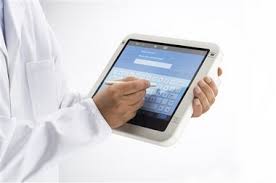
Second: Physicians and other health care professionals who are already familiar with the iPhone will have the ability to leverage a tablet in both the inpatient and outpatient settings. The iPad will become ubiquitous in the health care industry. You'll see them in hospitals, physician offices, etc. Doctors who are "on call" will use their iPad do access electronic health records (EHRs) and to place orders using computerized physician order entry (CPOE) systems. Some of this can be done with an iPhone, but the small screen size really limits your ability to work on such a device. The iSlate will overcome the screen size limitation and allow health care professionals to be much more productive when they're mobile.
So, do you believe that the iPad will revolutionize health care? I suppose it will ultimately depend on what this thing looks like.
Monday, January 11, 2010
Mobile computers in the hospital
 The last time you were in a hospital, did you notice many mobile computers? You may have seen some LCD monitors mounted on a rolling cart. Maybe you saw some nurses carrying little tablet-shaped mobile clinical assistants (MCAs) like the Motion C5. As hospitals become more digital, they will incorporate more computers into patient rooms, the walls, the waiting rooms, the common areas, and even the operating rooms. We'll have computers everywhere and they'll rely on wireless technology like Wi-Fi to communicate. Doctors will use them to enter orders (CPOE). Others will check labs and other test results on computes. Patient will also get to view some of their own health record information on tablets and other types of mobile devices. Plus, you can expect that doctors, nurses, pharmacists, and social workers will all carry some type of mobile computer. The world of mobile computing will continue to explode in the health care industry as medical professionals recognize their need to stay connected and have access to vital information.
Thursday, August 6, 2009
Tablet PC use will increase among physicians in 2010

With all the recent talk about health IT in Obama's stimulus plan, do you think that more doctors will be using tablet PCs with their electronic health record (EHR) solutions? Yes!
CrunchGear has a story that evaluates the Tablet PC industry. Is 2010 the year of the tablet? Nah.
Well, that may be true if you're thinking about the consumer market. However, the healthcare segment will definitely see an increase in tablet PC usage. Already, medical students in certain medical schools are required to have a Lenovo Thinkpad X200 Tablet PC during medical school. Physicians will be required to have a level of computing proficiency as they use EHRs and e-prescribing on a routine basis. Let's not forget about CPOE (Computerized Physician Order Entry).
So, will we see an increase in tablet PC use among physicians in 2010? You bet! As long as EHR vendors continue to deploy systems that leverage pen-based data entry and they package their solutions with leading tablet PC manufacturers, then we'll definitely see some significant traction among healthcare professionals.
Friday, May 22, 2009
What Role will Netbooks Play in Healthcare?
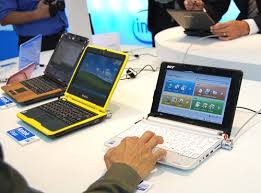
What role do netbooks have in the world of medicine? Do doctors and other healthcare professionals use netbooks? Are they more like toys or do they serve a practical application?
Here are my two cents ($0.02):
- More medical students will purchase and use a netbook so they can have something small and light when they go to the bookstore (or Starbucks) to study. After all, netbooks are inexpensive and medical students don't typically have a ton of cash. These students are more likely to continue using netbooks as they recognize the value of mobile computing. As a result, they will be netbook users during residency and even after they complete their training.
- Because of the recent push to implement electronic health records (EHRs), we will see more EHRs being utilized in the near future. This may also translate to an increased use of computerized physician order entry (CPOE). This means that physicians who are "on call" may need to have access to a computer if they wish to enter orders. Instead of carrying a laptop when they go out to dinner (or to a party or any other social engagement), they may opt to carry a really tiny PC (also called a netbook) like the Sony Vaio P. This thing is so small that it fits into a purse! Netbooks may become the perfect companion of physicians who need to have access to a computer for their CPOE needs.
Image source: TechBot
Subscribe to:
Posts (Atom)