Showing posts with label apple iphone. Show all posts

Wednesday, July 7, 2010

GlaxoSmithKline and MedTrust Online launch an oncology clinical trials iPhone app

This is being republished from MedicalSmartphones.com

GlaxoSmithKline (GSK) and MedTrust Online (an online physician portal) have launched a geolocating iPhone app that lets docs look up cancer clinical trials for their patients. Here are a few snippets from a June 4 press release:
With CancerTrials App, cancer doctors can easily find and share information about experimental therapies in clinical trials with their patients.  CancerTrials App provides a quick search menu based on 12 common cancers and more advanced features that refine searches based on criteria such as gender, age, trial status and more.  Once relevant trials are found, results can be mapped relative to the location of the iPhone or iPad running the application.
"GSK Oncology has always been interested in providing doctors and their patients with the access to the right information about the best therapies that improve patient outcomes," stated Jeffrey Bloss, M.D., Vice President, Medicine Development Leader for GSK Oncology.  "We are pleased to work with MedTrust Online to bring simple yet highly effective information-based solutions to the cancer community."
CancerTrials App is the first release of a mobile application for several platforms that connects to MedTrust Online's proprietary databases of oncology information at www.oncocentric.com.  Solutions for RIM's BlackBerry and Google's Android operating systems will be released over the next several months.  Oncologists using mobile communication devices will be able to share more with their patients as they search for the best therapies available in their communities.
About MedTrust Online, LLC
MedTrust Online LLC, www.medtrust-online.com, provides oncologists with clinically useful technology applications and solutions. MedTrust Online brings together experts in oncology, information technology, computational biology, pharmaceutical drug development, and personalized medicine to capture, organize, analyze, integrate and present the most up-to-date medical facts from a vast array of sources. This data is provided to doctors in a comprehensive yet concise way at www.oncocentric.com.

Thursday, April 1, 2010

Voalté® Announces Support For Apple iPad

Mobile Healthcare – There’s a New Platform in Town
Voalté® Announces Support For Apple iPad, Integration Available by Apple Ship Date

SARASOTA, Fla. February 3, 2010 – Voalté®, the leader in Point-of-Care communication technology, today announced its Voalté One solution will be available on the Apple iPad platform. The application brings cutting edge communication technology to nurses and other point-of-care workers.

Voalté (nomenclature derived from Voice, Alarm, Text) currently consolidates all three functions on the versatile iPhone platform. The first-of-its-kind application enables users to send and receive text messages, make voice calls, and receive critical care alarms on the iPhone, providing faster response times to patient needs.

“We feel the iPad will be great tool for healthcare clinicians,” said Trey Lauderdale, vice president of innovation for Voalté. “While this is not necessarily a nurse’s only device, the increased screen size will be beneficial for physicians and other clinicians who want to connect with the EMR, view medical images, make diagnosis and educate the patient.”

Tuesday, March 30, 2010

Guided tours of the Apple iPad

Even though you haven't had a chance to hold an iPad, you can view these "guided tour" videos on the Apple website. This way, when you go to the Apple store, you'll be fully equipped to test the iPad so that you can determine if you should buy this device.

You're probably already familiar with the "pinch-to-zoom" feature that's found on the iPod touch and iPhone. Additional multi-touch gestures make navigation very easy on the iPad.   Well, I doubt I'll buy one this year, but maybe I'll get an iPad through a drawing or on Christmas.

To view the iPad Guided Tours, visit: http://www.apple.com/ipad/guided-tours/

Monday, March 29, 2010

The iPad as a patient empowerment tool

Patients want to be empowered. Physicians want their patients to improve the self-management of chronic conditions. Will the new Apple iPad bridge some of these gaps and become an effective patient empowerment tool?

On one hand, the iPad can be used by health care providers to teach patients about diseases and conditions. Imagine if every patient went to a doctor's visit with an iPad. The doctor could help the patient record some notes, access important patient education materials, and could also provide the patient with some digital media that could be used to help that patient manage his/her disease when he/she returns home. Patients frequently forget the majority of the conversation after leaving the doctor's office, so why not leverage digital media technology to capture some of the key points during that encounter with the physician?

When the patient gets home, imagine if he/she were to use the iPad as an entertainment device. Suddenly, the device could beep and remind the patient to take his/her pills. Also, a reminder could pop up to remind the patient to watch the disease management video that highlights some of the lifestyle modifications this patient needs to make over the next few weeks. The patient could record progress on the iPad and take the device to his/her next visit.
  • The large screen on the iPad is ideal for those who have poor vision.
  • The iPad is thin and light. It can be carried almost anywhere.
  • Most doctors will know how to use an iPad. Don't they already use the iPhone?
  • The iPad is easy for many people to use. After all, who's never used an iPod touch or an iPhone?
  • The multimedia capabilities found on the iPad can be used to teach and empower patients.
Some have said that 2010 will be the year of the tablet PC. I think it's going to be the year when mobile slate devices begin to revolutionize health care.

Monday, March 8, 2010

Should medical schools require an iPad?

We've heard of several medical schools requiring students to use either an Apple iPhone or iPod touch, but what about the iPad? Some schools have been experimenting with digital e-book readers like the Amazon Kindle. Medical textbooks are frequently filled with photos and other color-rich images, so the grayscale Kindle isn't the ideal e-book reader for medical students who wish to carry their textbooks electronically. This is where the Apple iPad could revolutionize the way medical students learn.

Will some medical schools try to educate their students using digital technology? I'm sure it's bound to happen. What I don't know is whether the iPad will improve the way students learn medicine. Since I'm a technology advocate, I could make several compelling arguments to say that interactive learning is much more effective than traditional lectures and didactic education. I could also say that retention could be enhanced with the use of digital quizzes that occur at the point-of-learning. You can't do that with a text book, but you could do that with a digital version. I could argue that multimedia enhances the educational experience compared to static color images. But all these arguments could fail if students are not ready and willing to embrace technology to enhance their education.

The average pre-med college student is probably tech-savvy and digitally connected via a smartphone, several social media accounts, and a laptop computer. If you hand that student an iPad filled with medical textbooks and multimedia resources, will that student learn effectively? I would think so.

Wednesday, February 10, 2010

One in Five Physicians Likely To Purchase an iPad

One in Five Physicians Likely To Purchase an iPad, More than 60 Percent Intrigued By New Device According to Epocrates Survey 

SAN MATEO, Calif.--(BUSINESS WIRE)--Epocrates, Inc., today announced its top-ranked clinical reference application for the iPhone® and iPod® touch devices will be customized for the new iPad™ computer tablet. The iPad is already receiving a warm reception from the healthcare industry with nearly 20 percent of clinicians expressing plans to purchase in an Epocrates survey conducted days after the Apple announcement.

“By optimizing our software for the iPad, we are capitalizing on the larger screen real estate and interactivity provided by this sophisticated device. We are committed to providing the most productive experience at the point of care, keeping physicians informed and focused on the patient rather than searching for answers”

“By optimizing our software for the iPad, we are capitalizing on the larger screen real estate and interactivity provided by this sophisticated device. We are committed to providing the most productive experience at the point of care, keeping physicians informed and focused on the patient rather than searching for answers,” said Rose Crane, chief executive officer of Epocrates. “We are continuing to explore the advanced capabilities of the iPad and ways it can help Epocrates address the evolving healthcare technology needs.”

In addition to announcing its engineers are using Apple’s SDK to optimize Epocrates’ offerings for the iPad, Epocrates surveyed more than 350 clinicians to gauge their interest in the new tablet. Findings include:

* Nine percent of survey respondents plan to buy the iPad when it was immediately available,
* Another 13 percent plan to buy it within the year,
* Thirty-eight percent of respondents expressed interest in the iPad with the request of more information to solidify their purchase decision.

Epocrates®, the first medical application available using the iPhone SDK, was quickly adopted by medical professionals across the nation. Today, as the most popular medical program in the Apple app store, more than one in five physicians are actively using Epocrates on their iPhone or iPod touch. The majority of Epocrates’ 275,000-plus physician subscribers actively use its free or premium software on a “smartphone” such as an iPhone, Blackberry® or Palm® device.

More than 900,000 clinicians worldwide rely on Epocrates software at the point of care to help improve patient safety and increase efficiencies with fast, reliable access to a host of clinical information, such as drug dosing, health plan coverage and disease treatment guidelines.

ABOUT EPOCRATES, INC.

Epocrates is a leading provider of clinical information and decision support tools to healthcare professionals. Epocrates currently has more than 900,000 healthcare professionals, including one in three U.S. physicians and 40 percent of medical students, in its active network. The company’s subscription-based services enable healthcare professionals to make more informed medical decisions, reduce medical errors and practice more efficiently. For more information about Epocrates, please visit www.epocrates.com/company.

Monday, November 16, 2009

Will the growth in health IT revive the tablet PC industry?


I use a tablet PC. Many other physicians also use a tablet PC in the office or hospital with their electronic medical/health record (EMR or EHR). However, there are many who use a convertible tablet and primarily use it as a laptop/notebook.

Will the growth in health IT revive the tablet PC industry as more physicians start using EMRs that leverage pen-based data entry? I think it would be fantastic to see a growth in small tablets (or ultra-mobile PCs) in the health care industry. There are many doctors who love technology and gadgets. As more embrace touch-screen smartphones like the Apple iPhone, they will recognize the power of multi-touch gestures and other features that are commonly found in tablet PCs.

As we see more health care providers make the switch from paper records to electronic records, let's hope to see a reviving effect in the tablet PC marketplace.

Saturday, September 19, 2009

Tumi made accessories for the OQO


Did you know that Tumi made a case for the OQO model 01? (they never made one for the model 02). Tumi makes many different computer cases, but I'm not aware of any case that's made just for a single type of device like the OQO. Then again, they do make an iPod case. However, when's the last time you saw Tumi make a case for a single type of computer?

Monday, September 7, 2009

How do you define "multi-touch" on a tablet PC?


The term "multi-touch" monitor has different meanings to different people. At one time, multi-touch was used to refer to a tablet PC screen that could receive input in multiple ways: 1) a Wacom active digitizer that required a special stylus pen (allows you to hover over the screen); or 2) passive touch with a finger, plastic tip, or just about anything else.

Now, "multi-touch" seems to be used more for capacitive touch screens that allow a user to place several fingers on the screen and allow finger gestures to translate into commands. We see this type of technology on the Apple iPhone, the Palm Pre, and others. The HP TouchSmart tx2z tablet PC series also advertises that its screen is a "multitouch" screen:
This tablet PC is also "multitouch" : you can use more than one finger (e.g., index and thumb) at the same time.
Windows 7 is supposed to incorporate some of this type of multi-touch technology on tablets that have capacitive touch screens. With these types of screens, a plain plastic stylus won't work.

So, how do you define "multi-touch"? It's starting to get confusing out there.

Saturday, August 22, 2009

Thoughts on the Apple tablet (giant iPod touch)


The upcoming giant iPod touch (Apple tablet) may be running the iPod touch OS (operating system). I doubt that it will run the full version of OS-X. The iPod touch OS may not be ideal for something as large as this upcoming tablet unless it's purely meant to be a multimedia device. I'm a pen-based computing guy, so I don't think the iPod touch OS alone will be sufficient for me. I need something more robust that allows me to run work-based productivity software. Maybe Apple is "beta testing" the tablet concept with this first generation model. I won't be surprised if subsequent models run a more robust OS that will allow for some type of pen-based computing.

Speaking of pen-based computing, this may be difficult if the upcoming tablet has the same type of screen that's currently found on existing iPods and iPhones. Although there are some stylus pens available for capacitive touch screens, the capacitive touch screen isn't the most popular type for pen-based computers. So, will the 2nd or 3rd generation models employ some type of dual-input screen? (capacitive and Wacom-based active digitizer?) Maybe by then, Apple will release a full Mac OS-X -based tablet computer.

Wednesday, July 29, 2009

Barnes and Noble eReader


There was a period in my life when I used to spend all my time at a Barnes and Noble bookstore. I used to read, study, browse the web, and even tutor students at the bookstore. Now, B&N is feeling the heat because the Amazon Kindle has taken off and the future is e-book or e-reader technology. B&N is planning on working with Plastic Logic to create an e-book, but in the meanwhile, they're working on getting a head start. They've announced free eReader software for the Apple iPhone/iPod touch, BlackBerry, the PC, and the Mac. Where's Windows Mobile in all this? What about webOS on the Palm Pre or Google Android?

Well, I suppose if they can get many subscribers to start using this eReader software, then it'll be much easier to switch to the e-book made by Plastic Logic.

PC Magazine has reviewed the Barnes and Noble eReader software.

Bottom line:
Barnes & Noble joins the e-book fray but, unlike Amazon, doesn't make you buy an expensive reader. The Windows software is serviceable and the iPhone version outstanding, but the Mac version could stand beefing up.
Pros:
  • Huge library of titles.
  • Cross-platform support.
  • Excellent iPhone reader.
Cons:
  • Books can't be purchased within app.
  • Bare-bones Mac version.
Do you see yourself migrating to an eReader of some type? I already do all my reading on my Thinkpad X200 tablet. Since it's a convertible tablet, I can swivel the screen and hold the machine in my hand when I'm on the plane. It's a great way to read PDFs.

Monday, June 8, 2009

Are Smartphones Mobile Computers?


This has been a topic of debate for a long time. People are trying to use their smartphones as mini computers. There are magazine advertisements and television commercials out there about using smartphones to "work from phone" (instead of work from home). What can you really do on a smartphone?

As smartphone operating systems become more powerful, they are essentially turning into mini computers. People are running Microsoft Office on their smartphones. Windows Mobile comes with mini version of Word, Excel, and PowerPoint. You can run these same applications on other devices through third-party software vendors.

As cloud computing becomes more prevalent in the healthcare industry, the use of netbooks and smartphones may get incorporated into standard operating procedure (SOP). Maybe those people who are over a certain age will be exempt from using these machines that rely on tiny screens. Image source: slashphone

Monday, May 18, 2009

What's Your Favorite Gadget?


I love gadgets. I blame that on my MIT education. I just fell in love with technology at MIT. That's why I like to write about medicine and technology.

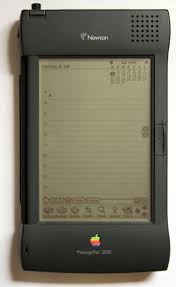
What's your favorite gadget? I'd have to say that my favorite is the Apple Newton Messagepad 2100. Why? Because it was so innovative for its time. It had a processor that was much faster than most processors found in laptop computers. Plus, the handwriting recognition was unbelievable! It used standard AA batteries, so I even traveled to China with my Newton because I knew that I wouldn't have any problems finding AA batteries.

So, what's your favorite gadget? I'm willing to bet that many young people would say the Apple iPhone. Some may even remember the days when Sony came out with the original "Walkman" (yes, I had one of those).

Thursday, April 30, 2009

What is the Apple "Media Pad"?


CNN has a story about the rumored Mac-Tablet (or Media Pad). You can call it what you'd like. I'm sure Apple will come up with a really clever name that has an "i" or "mac" in the name of the device. (iTablet, iNote, MacTablet, MacNote, MacPad, iPad, MediaMac, MacMedia). You can bet that it won't have the letters "PC" in the name, even if it ends up being an ultra-mobile PC.

So what do we know about this device so far? It will be larger than an iPhone, smaller than a MacBook, and it won't have a keyboard. Well, maybe we're not totally sure about the keyboard part yet. My gut tells me that it will be similar to these UMPCs like the Samsung Q1 and Q1 Ultra.

Saturday, April 25, 2009

Apple: Over 1 Billion Downloads in 9 Months


Wow, you can have a baby in 9 months! It's quite amazing that Apple has announced that they've had over 1 billion downloads! I must have contributed to that number since I installed all sorts of free programs on my iPod touch. There are a growing number of medical applications for the iPod Touch and iPhone. The iPhone has become the first-line medical PDA or smartphone for many clinicians. Is it the best medical smartphone for 2009?

Friday, April 10, 2009

At what point is a PC too small?

We live in a world of mobile technology. We see PDAs, BlackBerrys, iPhones, Smartphones, iPods, and all sorts of other mobile devices. Computers are also getting smaller and we see young people using UMPCs, netbooks, micro PCs, and other miniature computers. But at what point is the PC so small that you fail to be productive? At what point does the small size hinder your ability to do what you need to do? How do you balance size, weight, and functionality? After all, you can probably find a PC in a very small size, and then if you look some more, you can probably find another one that's 25% larger. So how should a physician, pharmacist, or nurse decide on the size of that mobile PC when working in the clinical setting? At what point is an ultra-mobile PC too small?